A chip that makes and amplifies light
A perovskite experiment brings light generation, amplification, and phase control onto one platform.
In brief
- The device combines guided emission, amplification and phase control at room temperature.
- Gratings built into the perovskite help direct and reflect light. The paper reports tests of the individual functions.
Primary source Peer-reviewed paper
Fully integrated perovskite active polaritonic circuits
Nature ·
What remains open. The paper demonstrates optical functions in a lab device. It leaves system efficiency and manufacturing yield open.
What was demonstrated
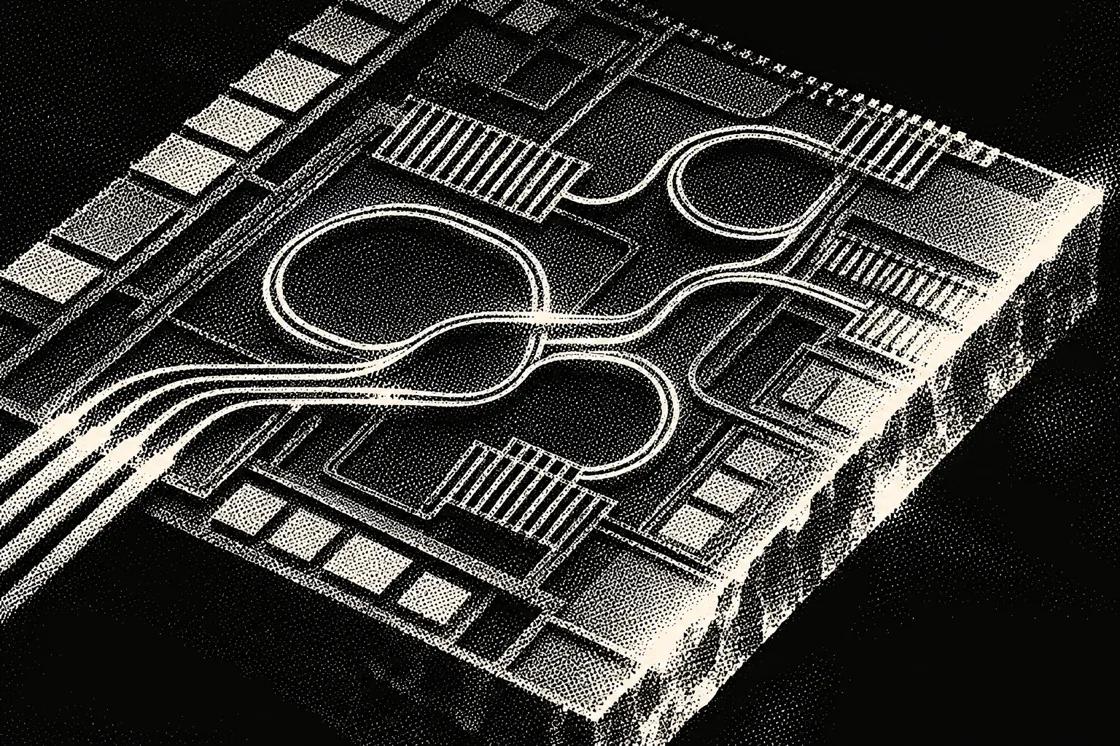
A team reporting in Nature built a perovskite circuit that generated guided light, amplified a signal travelling along a waveguide, and controlled its optical phase. These functions all used the same material platform and the experiments operated at room temperature. [1]
An active circuit needs ways to generate and alter a signal as it moves across the device. The experiment is interesting because it puts several of those operations on one platform. It makes it possible to study how they interact as parts of a single device. [1]
How it works
The waveguides carry exciton–polaritons, excitations with both light and material character. The researchers grew patterned perovskite structures with gratings built into the waveguides. Those gratings can couple light into and out of the guides and act as reflectors. Two reflectors form a cavity that can sustain guided emission. In separate measurements on the platform, the researchers used optical excitation to amplify a travelling signal and change its phase. [1]
What to watch next
The next useful comparison would be a complete system measurement. It would include the energy needed to excite the device, the losses at its inputs and outputs, and how closely different fabricated devices match. Those figures would help determine where the integration could give a practical advantage.
Sources
- Fully integrated perovskite active polaritonic circuits
Nature · Peer-reviewed paper ·